Ukraine and the Summer of 1943
With the recent announcement of Donbas ’43, we thought it worthwhile to cover some of the history and development behind the growing stable of 1943 Eastern Front titles.

Looking back at Panzer Campaigns, there has been a growing focus on the 1943 battles in Southern Russia/Ukraine. To date, the following titles have been developed:
Kursk ’43. Covering the complete Kursk operation, including both the northern (Army Group Centre) and southern (Army Group South) offensives in July 1943. Released in 2002
Kharkov ’43. A February / March 1943 title covering the Soviet capture of Kharkov, Manstein’s Backhand Blow counteroffensive, and the subsequent German recapture of Kharkov. This title chronologically preceded Kursk ’43 and created the bulge that the Germans subsequently attacked. Released in 2010.
Mius ’43. This Demo title included scenarios of the Mius River assaults in July 1943. Released in 2011.
Kiev ’43. This title covered the Autumn 1943 campaigns to cross the Dnepr River at Kiev. Released in 2021.
Rumyantsev ’43. With an included revamp of the Kursk southern flank, Rumyantsev’s primary focus was on the operation of the same name, the immediate Soviet counterattack after the German assaults at Kursk failed. Scenarios for July and August 1943 are included. Released in 2022.
Orel ’43. Like Rumyantsev ’43, Orel ’43 is focused on the Soviet response to the German Kursk offensives, but on the Northern flank. This title covered the Soviet push to capture Orel and the subsequent German withdrawal. The northern flank of the Kursk operation was also included. July and August 1943 scenarios are included and a subsequent expansion for the Soviet Bryansk offensive added content for September 1943. Released in 2023.
Smolensk ’43. This title covered the sector north of the Orel ’43 operations. The Soviets, sensing that the Germans had been weakened by the Kursk offensive, tried to pressure the Germans in multiple locations. The Smolensk title covers Operation Suvorov, with scenarios in August and September 1943. This game was released in 2024.
Donbas ’43. The Soviet operations at both Izium/Barvenkovo and the Mius River in July and August 1943 were a continuation of the offensives that were hoped to collapse the German frontline. This title expands on the scenarios in Mius ’43, covering the area directly south of the Kursk offensive down to the Black Sea. This title is planned for release in 2026.
Of the above, eight titles, all but Orel ’43 and Smolensk ’43, cover the operations of the German Army Group South and the opposing Soviet Fronts. Both combatants understood the importance of the natural resources of Ukraine as well as the opportunity to pin German forces against the Black Sea or isolate them in Crimea. Crimea was also seen as a gateway to Romania. Soviet bombers based here could reach the Ploesti oilfields, endangering the principal source of oil for Germany.
From the preceding listing of titles, it is obvious that the bulk of Panzer Campaigns titles released since the WDS purchase in 2021 have been in this theatre. This has largely been driven by two factors. The first is the interests of game designer Dani Asensio. Dani designed Rumyantsev, Orel, Smolensk, and the soon-to-be-released Donbas. As a ‘modder’, Dani had scenarios ready for the first three titles listed, and with some WDS tutelage, these became full games.
The second factor was the time period. 1943 is usually typified by the Kursk operation to the detriment of the many other operations of that year. Both the Soviet and Axis forces were closer to parity in 1943 than in any other year, yet there are very few simulations covering the various operations. This parity was evident both in forces and doctrine. The Soviets had been honing their armoured forces, based around Tank Corps and Tank Armies since June 1942, allowing them more tactical flexibility and the ability to utilise more manoeuvre warfare. There were still painful lessons, as evidenced by Manstein's Backhand Blow, but the Soviet Tank forces were to be feared in the summer of 1943. Couple this with the depth of formations and reserves available to the Russians, and the dearth for the Germans, created a situation where mobility was required, whether it was in attack or defence.
With Kursk, the introduction of improved German tanks also saw a technical transformation. The Soviets had surprised the Germans with both the T-34 and KV series of tanks. These vehicles were to out-gun and out-armour the Germans until the introduction of the long 75mm armed Pzkw IVF2’s in mid-1942 and the Tiger tank in late 1942. Though still low in number by July 1943, these new German vehicles, along with the troubled Panther, saw the Soviets realise that the T-34 armed with the 76mm gun was obsolete. This was to significantly increase the Russian tank losses during the summer 1943 offensives. To read a little more about the Soviet efforts to compete against the new German panzers, see this article on the KV-85, here.
Focusing on this period, Dani’s research indicated that multiple titles were possible, and that has driven the number of games both published and planned to date.
The following map is a good illustration of the 1943 operations in Southern Russia/Ukraine. This map covers the post-Kursk period from August 18th through to the end of 1943.
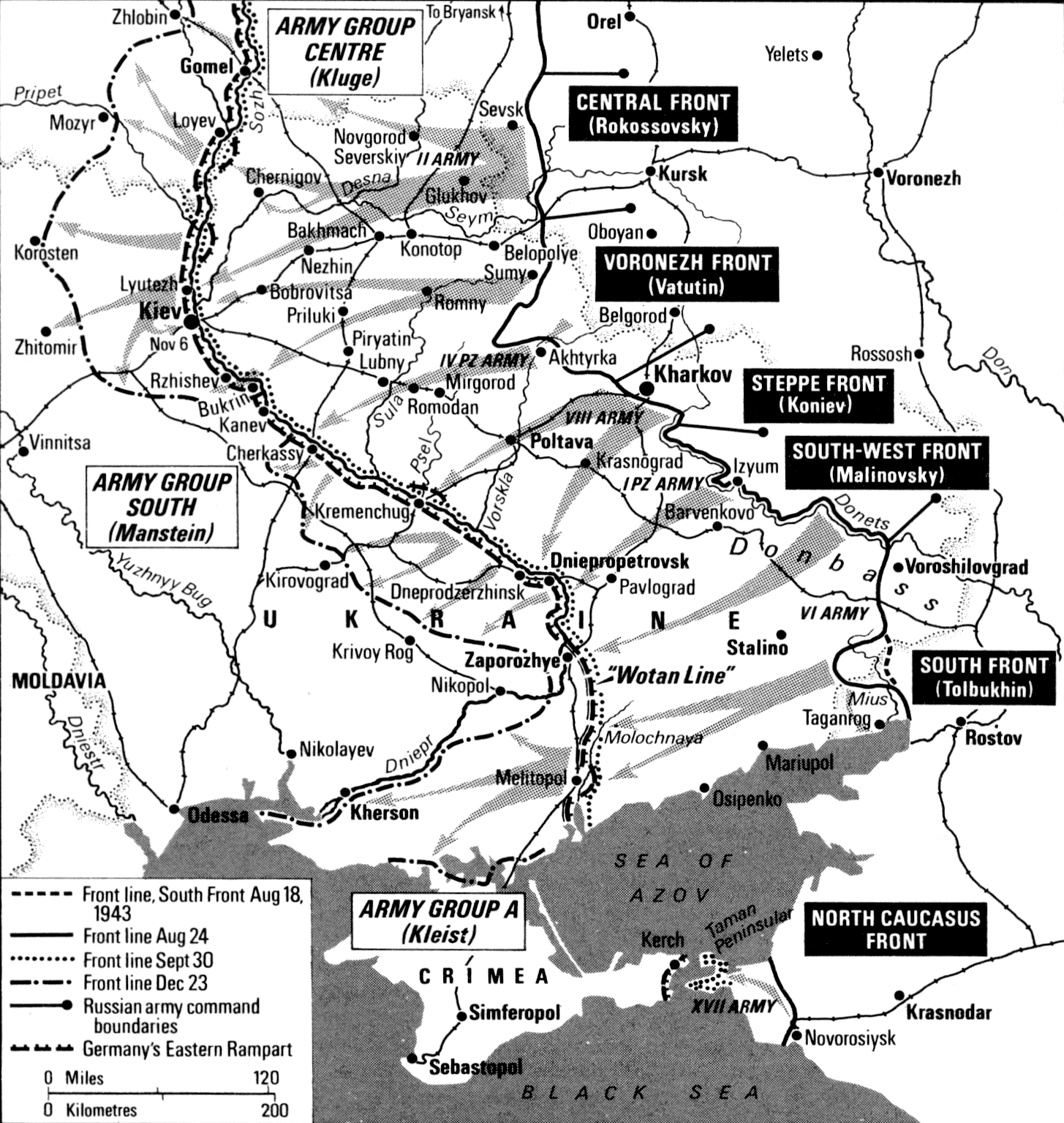
As shown on the map, the Axis forces attempted to place their primary defensive lines on major rivers where possible.
From summer 1942, while campaigning in Stalingrad, the Don River was the limit of the Axis advance.
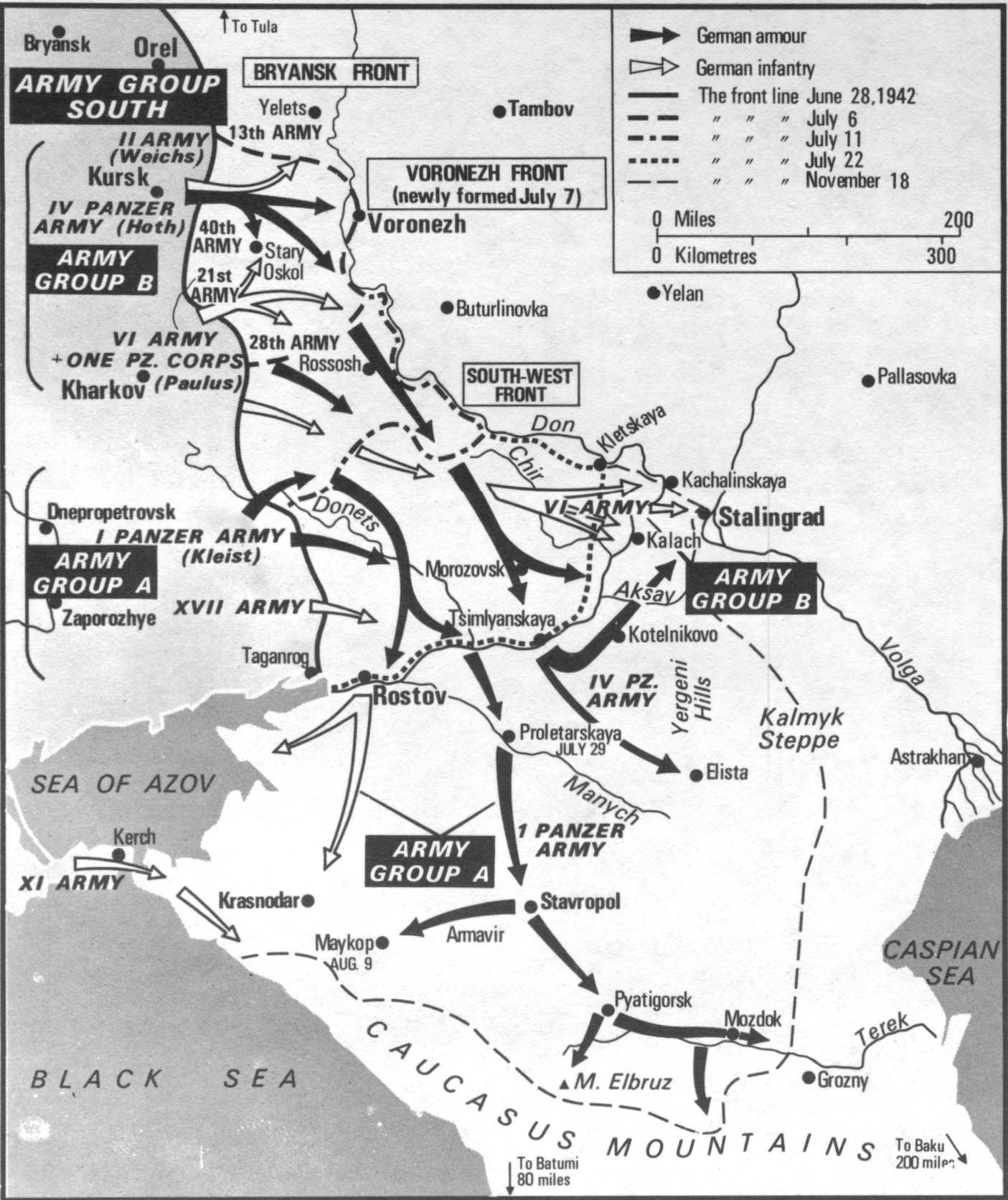
The Soviets collapsed this line when they breached the Axis minor armies to the north and south of Stalingrad. With insufficient forces and the impact of both Winter and the Soviet Operation Mars at Rzhev in Army Group Centre’s area of responsibility, there was little in the way of additional reinforcements. This followed a similar path to the strategic reversals in the winter of 1941/1942.
The differentiator in Winter 1942/1943 was that the German lines were significantly further advanced into Russia, and the Stalingrad breakthrough threatened a whole army group with isolation in the Caucasus. Holding Rostov on the Black Sea would be key to any attempt to retreat. The Germans managed to rescue Army Group A, but at the cost of the beleaguered Sixth Army, which essentially pinned significant Soviet forces at Stalingrad, while the Army Group retreated.
From November 1942 till March 1943, operations were essentially a Soviet pursuit of the retreating Axis forces. With a primary focus on holding Rostov, all other sectors fell back toward the Donets River, the next planned Axis defensive line. This was compromised in February 1943, when Kharkov was captured, and the Soviet Tank Corps approached both Dnepropetrovsk and Zaporozhye on the Dnepr River. It was only the newly arrived SS Corps and the rescued Army Group A, that managed to destroy the Soviet penetrations and recover the Donets River positions. These positions were to hold until after the German Kursk offensive.
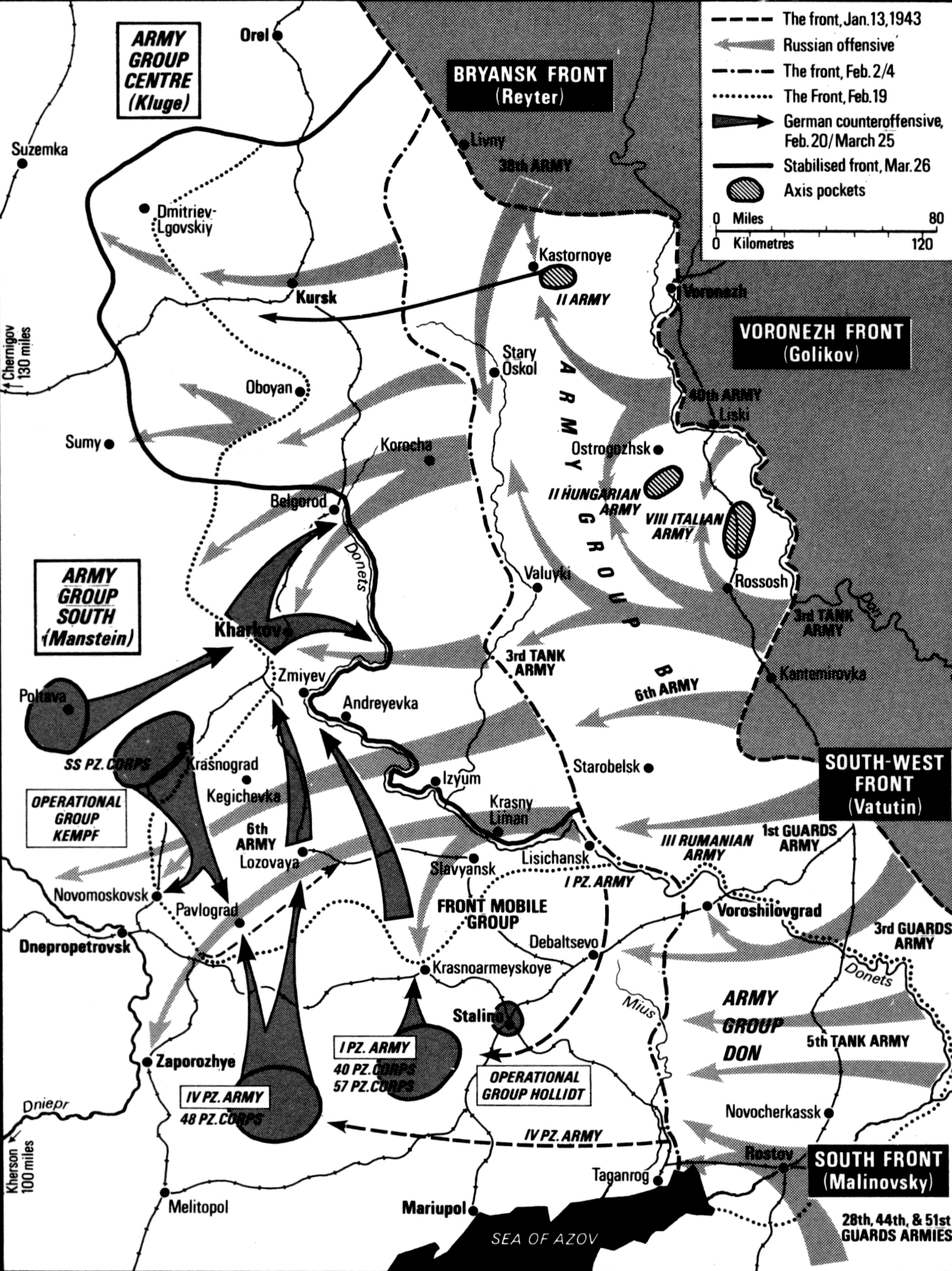
Post Kursk, the depth of Soviet reinforcements again became evident. Where the Germans had committed much of their strategic reserve and carefully reconstituted panzers to the July offensive, the Russians had planned to absorb the attack and then counter along the frontline. The Germans were forced to move back to a fire brigade defence, using mobile forces at the point of most threat. This was evident with heavy mechanised divisions like the SS Panzers or Gross Deutschland dispatched across the front as needed. Unable to be strong everywhere, the Germans had to move to a more mobile defence, particularly when the Donets River was breached in multiple places.
The situation became worse for the Germans when 1st SS Panzer-Grenadier Division Leibstandarte was dispatched to Italy to counter the Sicily Invasion in mid-July.
The battles through the summer of 1943, saw the Axis fall back to the last great river line, the Dnepr and the so called “Wotan Line”. That said, unlike the withdrawal from the Don River to the Donets, this was not a wholesale retreat. The Axis attempted to hold ground wherever possible, and in cases where the armoured fire brigade units were available, able to stall many Soviet advances. Unlike in March 1943, when the Soviet Tank Corps was routed due to extended supply lines, the advances were marked by cooperation between the Infantry and Tank Armies. The Russians even attempted special operations like the amphibious landing at Novorossiysk, Taganrog, and the parachute assault at Kanev, all to try and unhinge the German defences.
For further reading on the 1943 battles, see the following books:
“Last Victory in Russia: The SS-Panzerkorps and Manstein’s Kharkov Counteroffensive - February-March 1943” by George M. Nipe Jr.
A very detailed history of the operation from a primarily German perspective. It sets the scene of the desperate retreat after the Soviet attack at Stalingrad and the abandonment of the Caucasus, leaving both sides attempting just ‘one more’ push.

“The Battle of Kharkov, Winter 1942/1943” by Jean Restayn.
This is an excellent photo book that covers both the forces, landscape, and climactic conditions that confronted both sides.

“Platz der Leibstandarte: A Photo Study of the SS-Panzer-Grenadier-Division "Leibstandarte SS Adolf Hitler" and the Battle for Kharkov January-March 1943” by George M. Nipe, Remy Spezzano
This is another picture book that was authored by Remy Spezzano. Remy, through his company RZM Publishing, publishes works with remastered photos. Many are taken directly from the negative sheet and adjusted for balance and clarity. More importantly, they are put in the correct chronological order, and the captions reflect the actual action and location. Many historical photos that have been miscaptioned are in the appropriate context in this title.

“After Stalingrad: The Red Army's Winter Offensive 1942-1943” by David M. Glantz
David Glantz is one of the leading historians on the Eastern Front, specifically from the Soviet perspective. This book is described as:
Exploiting newly released Russian archival materials, it reveals the unbounded ambitions that shaped the Stavka's winter offensive and the full scope and scale of the Red Army's many offensive operations. For example, it reflects on recently rediscovered Operation Mars, Marshal Zhukov's companion piece to the more famous Operation Uranus at Stalingrad. It then reexamines the Red Army's dramatic offensive into the Donbas and Khar'kov region during February, clearly demonstrating that this offensive was indeed conducted by three rather than two Red Army fronts. Likewise, it describes how the Stavka expanded the scale of its offensive in mid-February 1943 by ordering major strategic efforts, hitherto ignored, by multiple Red Army fronts along the Western (Orel-Smolensk) axis and, in Zhukov's forgotten operation Polar Star, along the Northwestern (Demiansk-Leningrad) axis as well.
Finally, by restoring the full scope of these failed or partially failed Red Army offensives to history, this volume also reassesses the impact of Manstein's dramatic counterstrokes in the Donbas and Khar'kov regions, concluding that their impact was equivalent to that of a full-fledged strategic counteroffensive.

“Retribution: The Soviet Reconquest of Central Ukraine, 1943”, by Prit Buttar. This is an excellent background book to understand the events that directly followed the German Kursk offensive and the Soviet offensives that were not to stop until the fall of Berlin.

“From the Don to the Dnepr: Soviet Offensive Operations, December 1942 - August 1943”, by David Glantz. Another important volume that explains the situation on the Eastern Front from Stalingrad to after the Kursk offensive.

“The Battle of Kursk: The Red Army’s Defensive Operations and Counter-Offensive, July-August 1943”, by Richard Harrison. This is the Soviet General Staff report on all operations related to the Kursk offensive and subsequent Soviet Orel and Rumyantsev response.

The “Decision in the Ukraine: German Panzer Operations on the Eastern Front, Summer 1943” by George Nipe Jr. is a great title for the post-Kursk period, including the Rumyantsev and Mius River operations.

The various design notes with each title include detailed historical backgrounds, aligned to the included scenarios. You can click each image below to access the notes:
Kharkov ‘43

Rumyantsev ‘43

Orel ‘43

Smolensk ‘43

Kiev ‘43

Back when Orel ’43 was released, we mentioned an overarching title called Donets Front ’43. Orel ’43 was the second title, after Rumyantsev ’43, of a proposed combined ‘campaign title’ covering the Summer 1943 operations. Campaign or ‘Front’ titles are a new style of Panzer Campaigns game, where a number of large scenarios from related titles would be combined to build theatre-wide campaigns.
Unlike a normal Panzer Campaigns title that ships with forty to eighty scenarios of various sizes, a Front title would probably only have four to six campaigns before variants are included, and be targeted at head-to-head or multi-player play. This is a further evolution of the Modern Campaigns: Danube Front ’85 concept, but focused only on campaign scenarios.
We are still evaluating the concept, but for Donets Front ’43, we are considering the following:
· Combining Rumyantsev ’43 and Donbas ’43 to cover the operations of Army Group South. We had previously planned to include Orel ’43, but that operation was primarily against Army Group Centre, and is a better match with Smolensk ’43. The focus of Donets Front is on Army Group South and the attempts to breach the Donets River and advance to the Dnepr.
· We are hoping to have the following campaign start points:
o Early July – just prior to Kursk
o Early July – Kursk attack committed.
o Mid-July – post Kursk with the Izyum-Barvenkovo and first Mius offensive
o Early August – post Kursk, Operation Rumyantsev starts.
o Mid-August - Donbas offensive and Rumyantsev culmination.
· How long each of these campaigns would be is yet to be determined, but there may be a version or two of each with different lengths. We do not expect to have any scenarios beyond September 1943.
· From a setup and variant perspective, we are considering the following:
o There will be limited ability to cross-attach units. There are settings in the OOB now that prevent attachments, so players cannot send one Soviet Front’s units to another, for example. This is to prevent the stripping of assets. There is nothing stopping a player from repositioning a whole Front or Army, but there will be the above limitations.
o The first campaign, just prior to Kursk, will allow the maximum flexibility. If the Germans choose not to attack, they can preserve their forces, but at a high cost in victory points. Included with this is the release of Soviet forces using the new conditional reinforcement rules. If the Germans have not taken particular objectives at particular times, then Soviet formations may be released early.
o Historical release schedules will be used for formations with potential strategy options to allow additional variations.
o Unit availability variations such as the retention of 1st SS Panzer-Grenadier Division Leibstandarte, or even the removal of all the SS Panzer Korps, as was originally mooted by Hitler for the Italian front.
· There will be AI scripting included, so technically the campaigns can be played single player, but considering the size and complexity of the scenarios, we are recommending head-to-head play.
· There is a third, unannounced title that is intended to be part of Donets Front ’43, but the campaign title would ship before that. Post the third title release, we hope to either expand existing or add new campaign scenarios to Donets Front ’43 as a free addition.
· We are treating Front titles as full titles, despite the small number of included scenarios. They will be priced at our standard $39.95.
Below you can see two jump maps testing a number of combined campaigns from Rumyantsev ’43 and Donbas ’43, on a placeholder map. These scenarios exist and are playable currently.
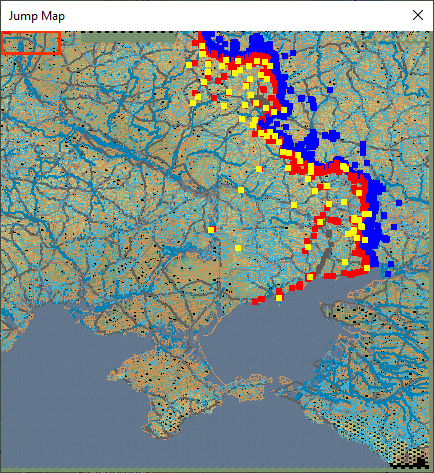
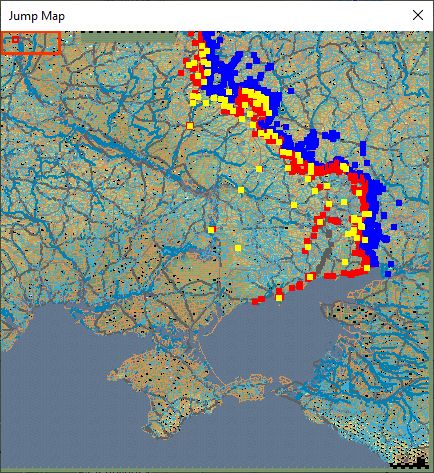
We need Donbas ’43 complete and released before we can integrate its content in Donets Front ’43. Once done, we need to create any missing content, as well as additional play testing. These will be very large scenarios, and we need to ensure that they run ok on typical PCs. We are not yet committed to publishing this title, and have some hoops to still jump through, but we would be interested to gauge the community’s interest in these Front titles.
We hope this article has helped guide you on some of the historical background behind the various Panzer Campaigns titles set on the Eastern Front in 1943, and where we hope to take the series in the future.


thank you for all the love you put into your craft. Rare thing these days. Can’t wait to get the new titles!
All good news and I’m looking forward to the new releases. But I don’t play H2H. I hope solo won’t be took much of an issue. Amazon should be paying you a commission of those titles and links that appear in your articles. Note that a significant portion of the Soviet mobility gains as the war progressed were due to Lend Lease.
As someone who deeply enjoys the larger campaigns, I would welcome this Front style of Panzer Campaigns entries gladly. I am very much anticipating this now, should it come to pass. Thank you all!
What fantastic news! At the moment I’m playing as the German side in Ukraine ’43 by GMT, and at the same time I’m studying Kiev ’43, Kharkov ’43, and Rumyantsev ’43, supported by what I consider important readings such as The Lost Victory (E. Manstein), Stalingrad to Berlin: The German Defeat in the East (F. Ziemke), and From the Don to the Dnieper (D. Glantz). With the upcoming release of Donbas ’43 and Donets Front ’43, the historical perspective broadens even further, and the study of this campaign expands accordingly
Leave a comment